Monday, February 5, 2018

Weekly Advice


  • It's highly likely that I say this a lot, but as an endurance athlete patience is absolutely critical.
    • If your "A" race isn't until the fall and right now you're worried about an upcoming event that is - likely - a single sport event, your concern is misplaced. Focus on the big things, not all the little things.
      • But focus on the little things too. They're just back burner things. Like keeping the beans warm. They're not mission critical, but they're a nice accent and good source of protein.
    • Success isn't overnight
      • Sometimes for every one step forward I take in the pool, I feel as though there are a corresponding 1.5 steps backward. This can even vary day to day. It can even vary within a single workout!
      • But, if you are patient (and your stroke doesn't suck or get worse), the speed will come
  • Also, as a human patience is critical.
    • If I need to bullet this out for you, there are other issues at play.

Those are some of the things that just need to be reiterated week after week. For the real "advice" column this week, we're going to talk about triathlon cycling and fitting.

  • If you get fitted to your tri bike, you should approach it with these things in mind:
    • What do I want?
      • From this fit. From triathlon in general. From your fitter. Do you want to take advantage of every piece of aero fruit your fitter says he or she can pick? (well, your fitter is likely exaggerating as they're probably not fitting you in a wind tunnel so they - like many others - are just guessing) Do you have a hip impingement but still want to get low? Do you just wanna make it through the bike and have your under parts remain in one piece?
    • What am I doing?
      • What's my schedule this year? What are my short and long term goals? 
    • What have I done?
      • Race wise, injury wise, fitness wise, etc etc etc
    • Is my fitter full of crap?
      • Tough to say, ask around. 
    • Am I full of crap?
      • Tough to say, ask around.
    • What's an efficient use of my time and money?
      • You wanna be efficient on the bike, AND with your money. If your fit costs hundreds of dollars and your fitter tells you that you NEED to spend another many hundreds of dollars (or more) on the piece of equipment that will TRULY get you as fast as possible, you should probably leave. Now, with that being said, if that purchase will allow you to hit the goals I mentioned above, then by all means, spend that cheddah. But spending all that money for a "maybe" is a tough sell. You can be aero, and you can almost always be MORE aero, but that "MORE" will cost you quite a bit, usually. Whether it be money, sustainability, discomfort, etc. it will take its toll somehow.
For your review: here's some blogs I've written previously about fitting (there have been a lot over the years).


And a video!

Tuesday, January 30, 2018

Weekly Advice (a day late)

managing various kinds of stress is difficult
  • if you're an athlete that works (most athletes) you've got:
    • stress about your fitness
    • stress about completing workouts as scheduled
    • stress about the quality of each workout
    • stress about work
    • stress about girls/guys/kids
    • untold other stressors
  • to that end, how do you minimize?
    • it's taken me quite a while to realize this, but...when I die I doubt I'll look back on that Saturday ride where I only managed 4 x 15' @ 280w when I was supposed to average 290w and say: "Well shit, that was pathetic."
    • setting priorities is important
      • your kids
      • your family
      • your house
      • your job (this could probably be interchanged a bit depending on how much the previous 3 rely on this one)
      • your social life
      • your happiness
      • your hobbies (i.e. triathlon) - this one should probably come last, let's be honest
    • be realistic
      • this is tough. i know self awareness is not always a glaring strength of many people, but really sit back and take stock of you and yours.
        • "is my training schedule realistic?"
        • "how is my work:life balance?"
        • "am i making generally good decisions?"
        • "what should my next lotto numbers pick be?"
      • you know, stuff like that
    • de-stress
      • take a little ''me'' time
        • spa day?
        • shoot off some gunz?
        • go karts?
        • driving range?
        • medicate
          • just kidding, except not really.

Monday, January 22, 2018

Weekly Advice

My number one top tip for you this week is:

Don't do stuff you're not used to. Remember last week (or the week before) when I said to challenge yourself and try new things? Yea, that was bullshit. That guy was an idiot. You should take everything he says with a massive piece of rock salt. Because this weekend that guy tried "a new thing."


When that "new thing" is an adventure run (could also be called a partial hike) that is 21 miles, gains 5000+ ft of elevation, and lasts 4.5hrs, well, that is something that you should TOTALLY DO. Even if your previous long run is only just under 2hrs. Strap up your camelbak, load some clif bars, and put on your dancing (/trail run) shoes and get after it.

I am writing this as I sit here the morning after, broken and on the couch. My feet hurt. My shoulders ache from the camelbak straps, my shins and arms are sliced to bits from all the plants - whose main goal it seems is to extract all of your bodily fluids - that we had to bushwhack through as we were lost near the summit of our trail. My body hates me. But it was awesome.

So, you know what? Follow that guy's advice. Do some crazy stuff. Just maybe don't go quite as crazy as he did. Crazy within boundaries, how about that?


Don't run into the Yucca, FYI

Hey Tucson

Snow at 7000 ft

Back down through the Canyon

Monday, January 15, 2018

Weekly Advice

It's early (ok, "mid") January, therefore it is important to:


  • Not care too hard about any performance whatsoever
    • For example, I just ran a 38+ minute 10k after a week of being sick. Was it lame? Yes. Does it matter? Nope.
    • Did your FTP test go poorly? Well, it's January. If your FTP test went really well I'd have much suspicion regarding how you spent your "off season." 
  • Do fun stuff
    • See previous post, and continue to reference this step throughout the year but with special focus on "winter" months.
  • Establish trends
    • Running 6 days a week? Check. Good trend to start.
    • Eating vegetarian? Meh, but give it a whirl.
    • Eating less dessert? That's a good, if not fun, trend.
    • Saving more money? This is triathlon, you don't get to save any of your money.
  • Do stuff that you won't have time for later
    • Doctor's appointments
    • House work
    • Cleaning your house
    • Making food at home
    • Saving money
  • Stay warm
    • Live in the Southwest
That does it for the weekly advice column. Follow these guidelines and you will be SET.


Monday, January 8, 2018

Weekly Advice

Since I am finally not feeling sick (don't tell that to the 30 minute run I did this morning though, blech) I am allowed to feel mildly inspired, so bear with me.

I have some over-arching thoughts on what the winter means for triathletes and some of the realizations that you should come to sooner rather than later if you're interested in long term success (note that "success" can be defined however you want it. A simple notion but one that is oft-forgot).


  • Don't get too caught up in what you eat or drink or do between Thanksgiving and the start of the New Year. If you don't vent a little, you'll explode. Just go watch the episodes of Mythbusters where they blow up hot water heaters to see how that looks. 
    • Just remember: everything in moderation
      • But it's ok to be excessive 
        • on occasion
  • Find some friends
    • This cannot be overstated. Humans need interaction. Most do anyway. Even if it's virtual. But in reality (haha, get it) we all need some face to face. Training is best done with buddies. You'll be far happier in the long term and you'll push yourself harder, generally.
      • That last bit can be a double edged sword. Be smart, don't get into too many d***-measuring contests. 
        • That isn't just a guy thing, either.
    • Get into some group stuff
      • And I don't mean the 3 way at the house down the street, I mean the swim group that some of your friends talked about last month, or the ''Vegetarian Potluck Friend Dinners" that sounds like a lot of work but actually isn't. Go bowling. Play TopGolf. Take dancing lessons.
  • Generally, don't be a dick.
    • This one seems easy and straightforward, but we all forget here and there. I generally forget when I'm online somewhere like Slowtwitch. Or I get an itchy clicker finger while reading some politically-infused social media post. But usually if I just write that email, or write that post, and then refrain from publishing and erase it, I feel way better AND I wasn't a dick! 
    • This one's tougher in winter because we're all generally in closer proximity with each other (especially you people in a place with a real winter; it's 75 here today FYI) and we tend to wear on each other a little more when we haven't seen sunlight in a while or our toes have been little blocks of ice cubes for the work week. 
    • Wave to people on your f***ing bike ride is a good start.
  • Experiment
    • Do different stuff. The "routine" and "consistency" are great when it comes to life and training, but we can really only burn so many "consistency" matches throughout the year. Take some time to store up some of those matches by doing something that is NOT routine, and is NOT about consistency. 
That's enough for this post. What are some fun things you tried this fall/winter??


Thursday, January 4, 2018

Remember, as a kid...

I used to WANT to be sick so I could stay home from school that day. I had strategies for this. My mom would bring the thermometer into the bedroom when I woke up saying I felt "bad" and when she left to go do something else I'd take the thermometer and stick it up close to the lamp's lightbulb by my bed. This was both genius but also a backfire, occasionally. My mom tended to not believe me when she came back and the thermometer said "180*" or something like that... But, if I could get the distance to bulb juuuust right, the temperature would be something believable. Voila!

Of course, when you're actually sick, you can't imagine EVER wanting to be sick. It basically feels as though you'll never be healthy again. You basically feel as though you will always be ''damaged goods.'' People have to take care of you, which you want but also don't want. Your normal routine gets put completely on hold. If you're an athlete, you kick yourself for missing scheduled or unscheduled workouts.

I am writing this (I'm sure you've inferred as much at this point) because I am currently sick with a fever. I've done a fair amount of reading as I've been waylaid in a far corner of the house so as not to get Christine sick. I finished the latest Jack Reacher novel and read Artemis today, the new book by Andy Weir (The Martian). Quick book review:

Reacher is still a fun character to follow. But each story (there's almost 20 at this point) grows a bit more predictable (in terms of story arc, not specifics). It's inevitable, I suppose. I can barely post a new blog once a quarter and this guy is putting out a NYT bestseller about once a year. Goals...

Artemis is an entertaining story, but there are some mildly odd factors present in its storytelling. Weird reliance on sex/vulgarity (for reference, there was no sex during the book, but it was discussed a lot) when it really contributed nothing to the story. It's hard to top that sort of: "Dang, this book is reallyyy entertaining and Watney is just a character that feels really...real and I really like rooting for him" when you finish The Martian.

Anyway, don't ever wish for being sick kids. It is no fun.


Thursday, November 9, 2017

Safest cities for cycling

A thread popped up on Slowtwitch this week that piqued my interest, because the "original poster" (OP) asked the question: "What city is the safest for cycling year round?" As you can imagine, every response has been different. Everyone that enjoys the cycling where they live (and those that hate it) has responded suggesting that, in fact, THEIR city is the safest. It's a fairly self-selected "poll," as the only people that will respond are the people that likely feel strongly about their answer. Plus, most people simply "lurk" on ST anyway and don't ever post, so the ''poll'' is extremely biased.

Anyway, it got me to thinking: what makes a city safe for cyclists?

Well, it really begins and ends with the city's civic planning system and infrastructure. Certain cities will likely never be "safe" for cyclists (all cyclists, whether they be recreational, commuters, messengers, hobbyists, just a bit of fitness, etc) because the city cannot change the existing patterns. Charlotte kind of feels like this. I cannot imagine Charlotte being a safe place to ride a bicycle outdoors. There is no room to change the dynamic. There are only so many ways "in "and "out" of places in the city that are just absolutely littered with cars. New Orleans is like this as well, but more so because the streets are so rough and relatively narrow and the city itself is so "hemmed in" by the surrounding landscape (a big ass river and a big ass lake) that the number of cycling routes to even get outside the city is basically...1.

Anyway, I could make a strong case for Tucson being one of the most bicycle friendly towns in the US (that I have been to and ridden my bike in <--- a="" drastically="" for="" great="" i="" nbsp="" reduces="" s="" sample="" size="" starters="" the="" there="" this="">government website
 (hmm, oxymoron anybody?) dedicated to the "Bicycle and Pedestrian Program." I'm actually just kind of diving into this website now but man, it is extensive. You can even get a list of current projects and see what is going on as it happens and in what stage of development are individual projects. But the over-arching goal seems to be connectivity and ease of use.

Cool bridges everywhere. You can look down on cars, literally AND figuratively

Signage is solid, but having google maps handy is equally solid

If I want to, I can ride basically anywhere in Tucson and follow protected bike routes. The protection can vary from "The Loop" (fully pedestrian/bike pathways) to "Bike Boulevards" ("residential streets designed to prioritize bicycle and enhance conditions for walking") to simple bike lanes on regular streets. The key point is that I can feel safe riding all 3 of those types of routes. There are definitely sections with more vehicular traffic than others, but I can design a route to minimize those parts and favor the safer parts.

Safety first

See? Cool bridges everywhere
Not only ALL THAT, but the routes for cyclists and triathletes outside of the confines of the city proper are, for the most part, very good. Lots of choices in all directions.

At the end of the day, we - as cyclists - can only control so many variables. I can have bright clothing, bright lights (day or night), a cognizance of the rules, etc, but it really all depends on the drivers and other cyclists. Unless we are truly protected via infrastructure and planning...it's an inherently risky activity! So, ride on! (safely)


Monday, October 23, 2017

What I've learned from 130+ straight days of running

So back in mid-April I was running with Christine and Amy while they were doing a long run and another local triathlete showed up from behind us as we were just starting. Ben is a very accomplished tri guy who had just recently had a very good race in Africa. During this run I asked him a few questions about his race and one of the things he said stood out to me at the time and it was basically about how confident he was in his run because of how consistently he had been running during his big training block leading into the race. He had inadvertently (somewhat) had a running streak going that ended the day after the Africa race. I didn't think too much about the idea of a streak at the time but as the spring and summer wore on and my training kind of took a nosedive I wanted to do something that would sort of galvanize some run fitness and consistency.

So a week or two after Deuceman (which completely kicked my ass) I decided I'd start a run streak. I'd run every day for at least 20 minutes. 20 minutes seemed like a good number; not too much and not too little. Anywhere from 2 miles on a real bad day to 3 miles if I was feeling uber-sporty. I started this streak with a trip up to Wasson Peak with Ryan, which was a tough way to start because that is a legit mountain climb...


From that day forward to now, I have run about 850 miles with quite a few double run days somewhere in there. I've done one race (World Champs), which made it hard to continue the streak in the first few days after the race. I've averaged about 6.5 miles per day, with a long run of about 17 miles.

Somewhere in there I decided to do a running race or two, and the first ''test'' will be this upcoming Sunday at a flat half marathon here in Tucson. So in the previous 4 weeks I've put in about 250 miles and had some pretty solid, quality workouts in there. I know none of this has been ''a lot'' of miles for a runner, but it's been a few years since I've really put in some solid run volume and for better or for worse I just always have been a run volume fan. I ''feel'' better as a triathlete when I am running 5+ times a week.

Anyway, I haven't done a half marathon as a stand-alone event since 2010 at Charlotte's Corporate Cup. And yes, I wrote a blog about that! I've had a few half-ironman runs that were actually faster than that race, but I've never really seen how close to the envelope I can drag myself with no swimming and no biking. I don't have especially high expectations, but I know for sure I will go sub 1:20 but above 1:15. So that's my best guess ;)

Regardless, what have I learned from this streak?

1) Running more makes you faster at running
2) Staying healthy when you're building can be difficult, but prevention is the best medicine
3) Running every day sometimes really sucks
4) You need many pairs of shoes and many, many pairs of running shorts or you're going to be doing a lot of laundry
5) In reality, if you are running 40-50+ miles a week, running every day is really not a great idea
6) You will likely hurt yourself
7) and discover how gross your feet can get

I know at the end of the day 130+ days and 40+ miles/week are not, by any means, a lot for a "runner." Be that as it may, it's more than I've done in quite some time and I've noticed the effects fairly dramatically in the past month. Paces that I've not done in a while feel - practically - easy and while little aches and pains have come and gone I've managed to stay healthy and in motion during the streak.

So, here's your final lesson:

1) It doesn't matter how fast you bike if you run like ass
2) More is more, until it's not
3) Some quality is better than no quality
4) Bike for show, run for dough

Monday, October 16, 2017

Mountain Biking for Dummies - TIRES

Everything that’s been said before, be it a general comment about frame type or what type of suspension to look for, doesn’t matter.  Yes, I said that.  All thousands of words I’ve already written on mountain biking are relatively useless if you don’t get the fourth part correct.  What IS that mystical fourth part, you ask? Well, it’s tire selection.

Why are tires so important?

That’s a good question, and it’s an easy one to overlook and take for granted. You can have the nicest $10,000 mountain bike with extremely high level components, suspension, and frame and yet be totally lost if you’ve got the wrong tire for the job you’re doing. Conversely, you can have an extremely beginner bicycle but if your tire is paired perfectly to your trail and riding style you can easily drop your buddy on the ultra expensive machine and, let’s be honest, who doesn’t like dropping their buddies every now and then??

I am, admittedly, being a bit dramatic (I tend to do that in these types of things) but that is ONLY to make a point! Any bike you buy will likely come with tires that are simply “pretty good” at most things.  They’ll do a fine job of accommodating your needs and desires.  That being said, as you become more and more familiar with your comfort level and appropriate riding skills you may find yourself wanting to explore tire choice and selection a bit more.  It’s different than road cycling, where tires are definitely important in terms of how fast you go or how many punctures you get but play very little role in how fast you can take a turn or how quickly you can slow down or get back up to speed.

Mountain bike tires essentially fall into two categories: tubed and tubeless (if we’re getting nitpicky you can also find tubular mountain bike tires, but those are not very common at all).  Tubed tires will be familiar to everyone that is familiar with bikes; there is an inner tube that is inflated and holds the tire’s shape.  TubeLESS tires have no inner tube; the tire hooks into the wheel’s rim and through a combination of specific rim tape and liquid sealant, stays inflated and rigid.


Tubed tires and tubes in general are the easiest from an upkeep standpoint.  If you get a flat you simply replace the tube. There is no sealant to refill and there is no difficulty in getting the tire to “attach” and inflate the first time you install it (which can be difficult with tubeless tires). The downside to a tubed system is that it generally weighs more and you run a higher risk of pinch flatting (this is what happens when you go over some sort of bump and the tire/tube compresses so much that the tire pinches the tube between the metal rim and the tire which, in turn, punctures it).  This is not particularly common in road cycling but, as you can imagine, is more common on trails as there are far more obstacles to roll over with your tires.  

Tubeless tires are generally considered preferable, as you eliminate the tube and any risk of pinch flatting.  You can run the tires at lower psi, which increases your available traction (the tire “grips” surfaces better) and the system usually weighs less.  There is less risk of flats as well, as the liquid sealant running around in the tire (about 2 ounces worth) rushes to the site of any small cut or puncture (think of the sealant as platelets in your blood!) and seals the hole and you can continue riding and may never even know you got a puncture.  Obviously, some cuts or punctures will be too big for the sealant and you should always run with a flat repair kit.  Installing a tube into a flat tubeless tire is very easy and is what almost everybody carries with them while riding (whether riding tubed tires or tubeless tires).

Every single mountain bike you buy, however, will come with tubes (as far as I’m aware, unless the shop has set it up tubeless out of the box). Most mountain bikes that are above $1000 or so are “tubeless” ready and you can easily ask your shop to set it up that way once you are comfortable with the idea.  You merely have to buy sealant and, potentially, rim tape; neither of these will set you back more than $30-$50 (including installation).

Tread types are very important when it comes to confidence and technical skill, so it’s important to learn some about what makes certain tires more suitable for certain conditions and different environments.


Tire tread is essentially composed of three elements: center knobs, transition knobs, and side knobs.  Each of those plays a pretty specific role in maintaining traction, which is a tire’s ultimate goal. If you are riding in loose soil you want deeper penetration. If it’s harder soil (think desert conditions) you don’t need as much penetration. So the SIZE of the knobs is important insofar as it relates to the density of your surface.

The number of knobs is also related to surface conditions; the more knobs you have the less each individual knob will penetrate the soil, which is what leads to traction.  So harder soil means you can run more knobs in your tread and maintain adequate grip. Looser soil means fewer knobs, each of which will penetrate the soil more.

The placement of those knobs is also important.  Looser soil means you generally need to have a decent amount of space between the knobs so that once the soil has been penetrated it has channels to run through, so to speak.  Loose OVER hardpack (commonly found in the southwest) generally demands this type of tire.  Nice channels that run between your side knobs and center knobs, but the center knobs can be more dense (i.e. more of them) while the side and/or transition knobs can be less dense but perhaps bigger.


Interestingly, riding style also plays a role in tire selection.  Some cyclists LEAN the bike quite a bit through turns and as a consequence they don’t really need transition knobs as they go from “upright” to leaned over and get plenty of traction and control in that leaned position.  So more “aggressive” riders tend to prefer a tire with bigger channels.  Riders who don’t lean the bike aggressively (which is most riders) find tires like that to have a sudden cliff in terms of traction.  They don’t lean the bike aggressively and therefore never really contact the side knobs, so the bigger channel robs them of confidence and traction in the corners.

Ultimately, tire choice is about experimentation.  Finding a good front/rear combination that works for you and your riding style/location is often trial and error.  Knowing certain things about tires themselves, however, can help you make more informed decisions.  I’ll give you my own personal example here:

In Tucson, leaning your bike (i.e. making aggressive turns) is difficult because it feels like there is  cactus around every corner.  So if I lean, I get spiked.  As a consequence, I do not turn or lean the bike nearly as aggressively as I did back on the east coast. So my tire choice in that respect is different.  The soil conditions here in Tucson are also wildly different than North Carolina.  The soil there was grippy, generally, and had a bit of give to it.  The soil here is extremely hard underneath a very loose layer of rock and sand.  So tire choice is different in that respect as well.  Furthermore, all of the rocks here are out to kill you and your bike.  So my tire choice needs to be a bit more durable (extra puncture layers or sidewall protection) if I want the tires to last more than a couple of weeks’ worth of riding.

So, it’s important to experiment and figure out what works best for you, where you live, and how you ride! But use some of these keys to help you make your decision!

Monday, September 25, 2017

Mountain Biking for Dummies, Part 3

For reference, here are parts 1 and 2.

Wheels, hubs, and axles OH MY!

Here we are in our third installment of The Mountain Bike Series!  We are now deeply educated individuals when it comes to the basics of mountain bikes in general and the basics of their suspension systems.  Along those lines, we’re going to take today to look into the basics of wheel systems.

The first step is to look at the various wheel sizes offered with off-road bikes, which come in varieties of 29 inch wheels, 27.5 inch (or called 650b), and 26 inch wheels.  For quite a long time, 26” was the only option.  You will still find 26” sized wheels on entry level bikes, youth bikes, and even some (adult sized) “downhill” bikes.  With the exception of the downhill bikes, you will really only find 26” on what could be classified as “entry level” bicycles.  It has been generally agreed upon that “bigger is better” when it comes to mountain bike wheel sizing.  

So most of the choices we - as new mountain bike purchasers - will make are going to fall into either the 650b or 29” category.  Let’s examine some pros and cons of each, shall we?

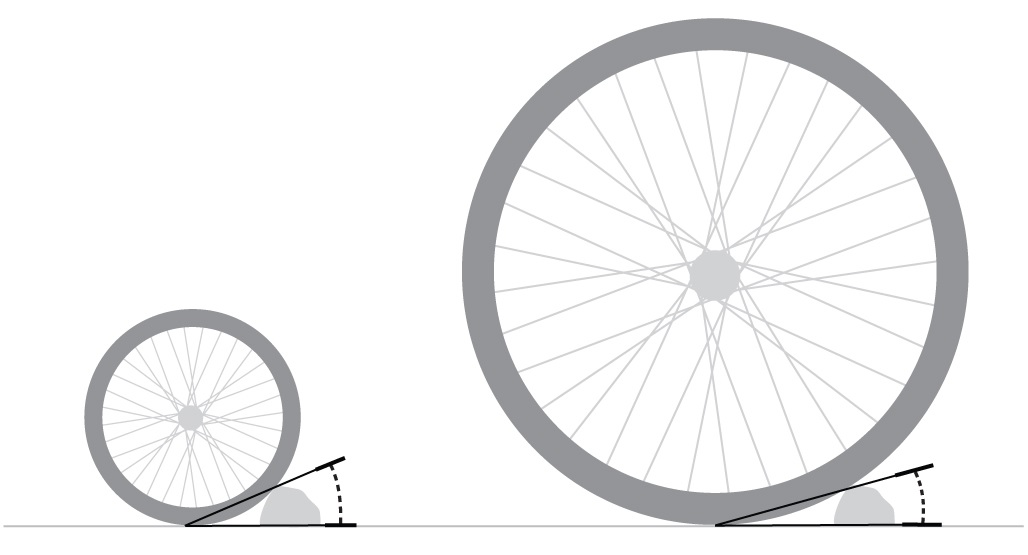
When 29” wheels first came out (which was before my time) they were - like many new things in the cycling world - met with skepticism.  These huge new wheels weighed more, looked silly, and couldn’t possibly be better, could they?  Well usually: yes, they are better than 26” wheels in almost all applications.  Some of the things you might not think about at first glance are the bigger contact patch with the ground and the shallower angle of attack these wheels will have as compared to their smaller brethren.  The bigger contact patch is simply due to the larger circumference of the wheels, which results in more of the tire coming into contact with the ground.  The benefits of this are obvious, as there is more grip for cornering and braking.  The shallower angle of attack is a little more difficult to explain, but it essentially means that every object encountered on the trail is smaller as it relates to the wheel itself.  As a consequence, a 5 inch tall rock which, with a 26” wheel, would’ve been met a bit more “head on” is now lower on the 29 inch wheel.  This picture makes it more obvious, although the size disparity is a little dramatic:

angle of attack.jpg
So the bigger wheel gives the rider a little more room for error.  It makes obstacles “ride” smaller, it makes drop-offs easier to deal with, and in general it feels as though you cover more ground more quickly as compared to smaller wheels.  The wheels do, in fact, generally run a bit heavier.  Is this a big deal? In my opinion definitely not, but some may argue that the bigger wheels are more difficult to “spin up” or get up to speed, but to be honest I have not compared a 29” bike to a 26” bike so can offer no personal perspective.  It IS noticeable, however, when doing tight and twisted singletrack at slow speeds that a 29” bike can have more trouble than a smaller wheeled bike.  The bike has a longer wheelbase and bigger wheels and, as a consequence, can be more difficult to maneuver around tighter, smaller radius turns.

The 27.5” or 650b standard is newer and was created in no small part to resolve some of the concerns mentioned in the previous paragraph (or maybe it was created just to create more bikes to buy??).  Without taking into context the size or style of a bike, the 650b standard is most often viewed as a “best of all worlds.” It has many of the benefits of the larger wheels, such as better angle of attack and bigger contact patch, but with a lessening of the drawbacks such as weight and maneuverability.  It is still a bit newer but has mostly caught up in terms of availability of tire selection and wheel brand choices.

In my personal opinion, if I am looking for a cross country or trail bike I am probably going to say go with whatever size wheel “feels” appropriate.  For example, on a medium or large (or extra large) bike, 29” wheels are likely NOT going to feel “big” to you.  On the other hand, if you ride a small or extra small frame then 29” wheels likely ARE going to feel big, and as a consequence I’d say focus more on 650b bikes lineups.  If, on the other hand, you are looking for a big hitter bike (all mountain, DH, etc) then it’s much more normal to see 650b wheels on those big travel bikes.  

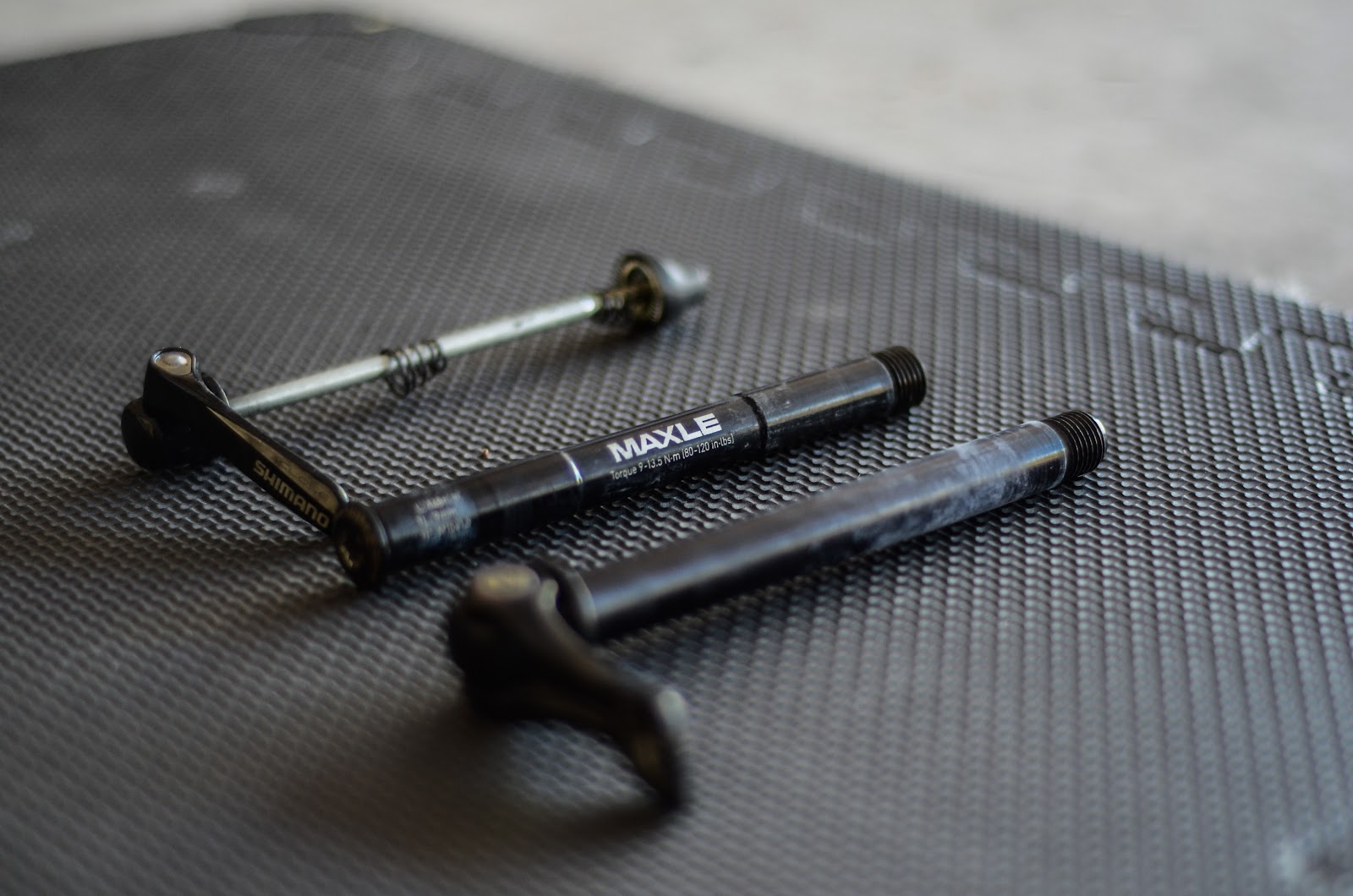
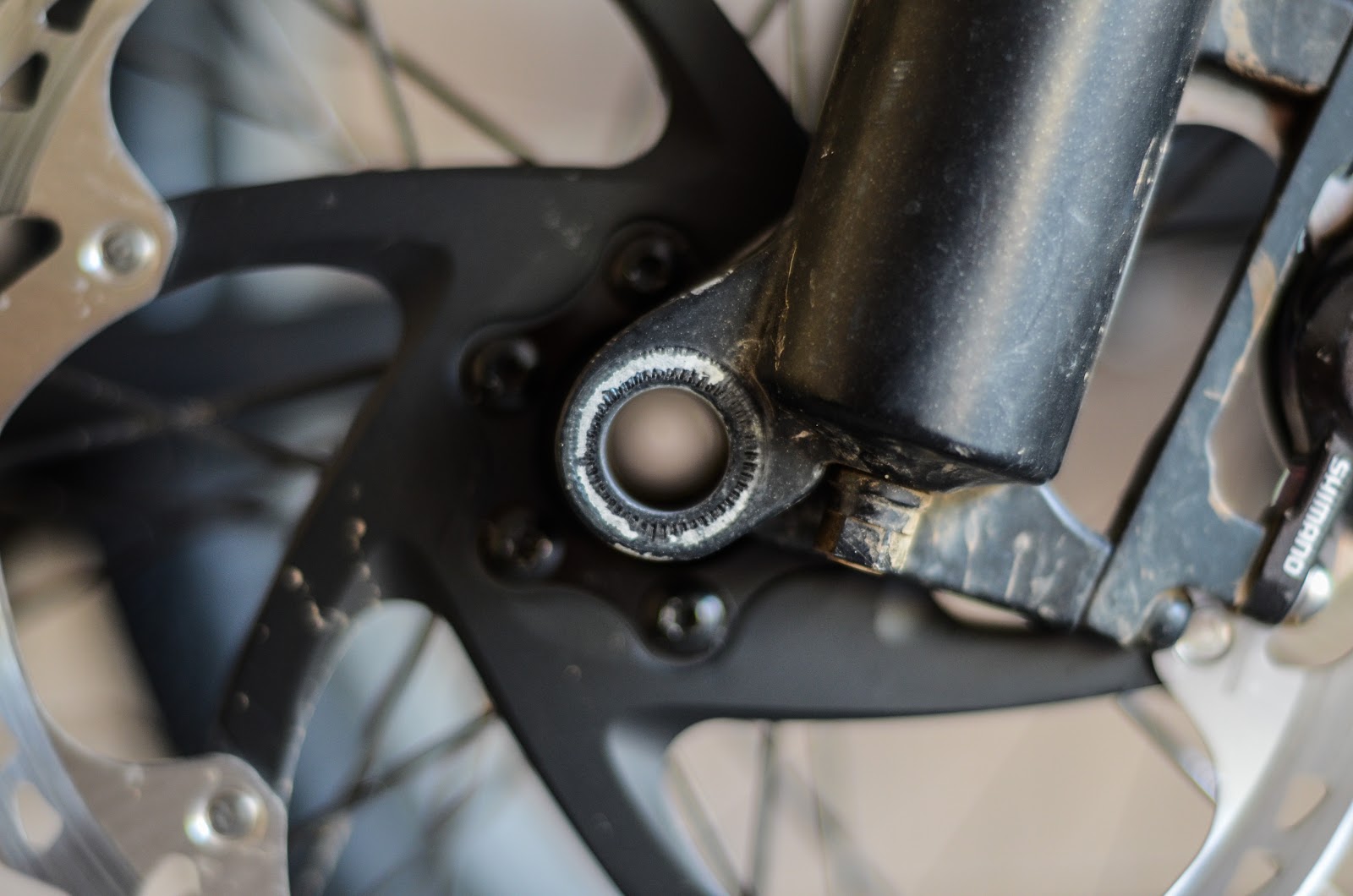
Let’s also take a few moments to talk about hubs.  Not just the hub itself, but how the wheels are bolted/attached to your frame.  We are ALL used to quick release skewers, as these have been used on bikes for quite some time.  The idea is pretty simple as it’s basically an axle that slots into your dropouts and is tightened using a cam pressure system.  For a long time, this was the most common thing seen on mountain bikes as well.  Nowadays, however, the system is completely different.

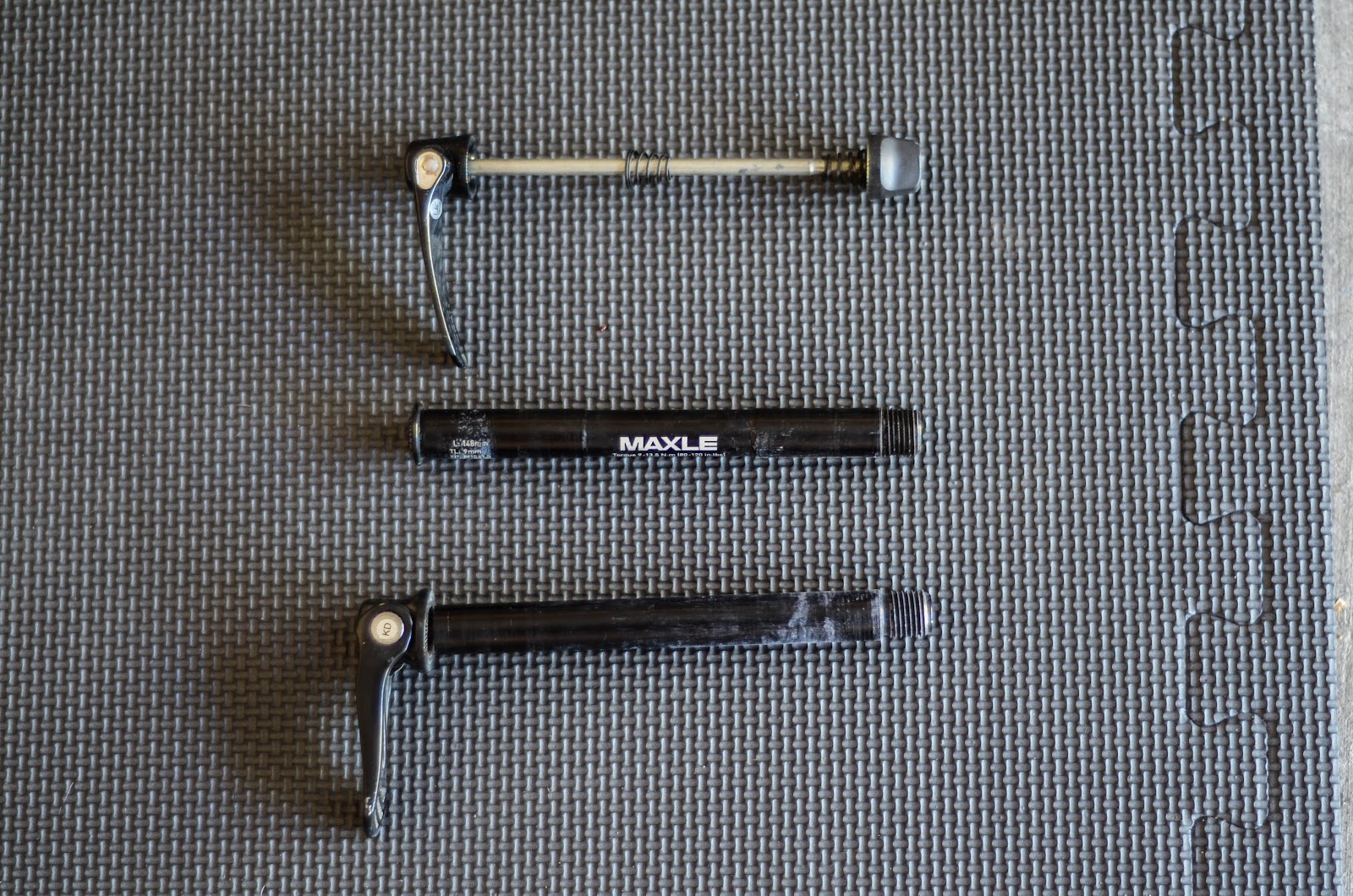
DSC_4024.jpgDSC_4025.jpg

Most off road bikes (this is now beginning to include cyclocross, gravel, and even some road bikes) now use what is called a “thru-axle.” The desire for this system began with a desire to increase the overall rigidity of a bike. Dropouts (the openings into which a wheel’s hub fits) are wider on a mountain bike to help achieve this.  The thru axle is another mechanism that aids this rigidity goal, as the axle itself literally bolts the dropouts together THROUGH the wheel’s hub.

Quick releases are usually 9mm, whereas thru-axles are generally much bigger.  At first, mountain bikes began utilizing thru-axles only in the front while still keeping a quick release in the rear.  Now, however, that has changed to be thru-axles on both the front and rear.  Whereas a road bike has dropout spacing (basically the width between the dropouts) of 100mm in the front and 130mm in the rear - with 9mm quick relases - modern mountain bikes are most commonly 100mm in the front (with a 15mm thru-axle) and 142mm in the rear (with a 12mm thru axle).  

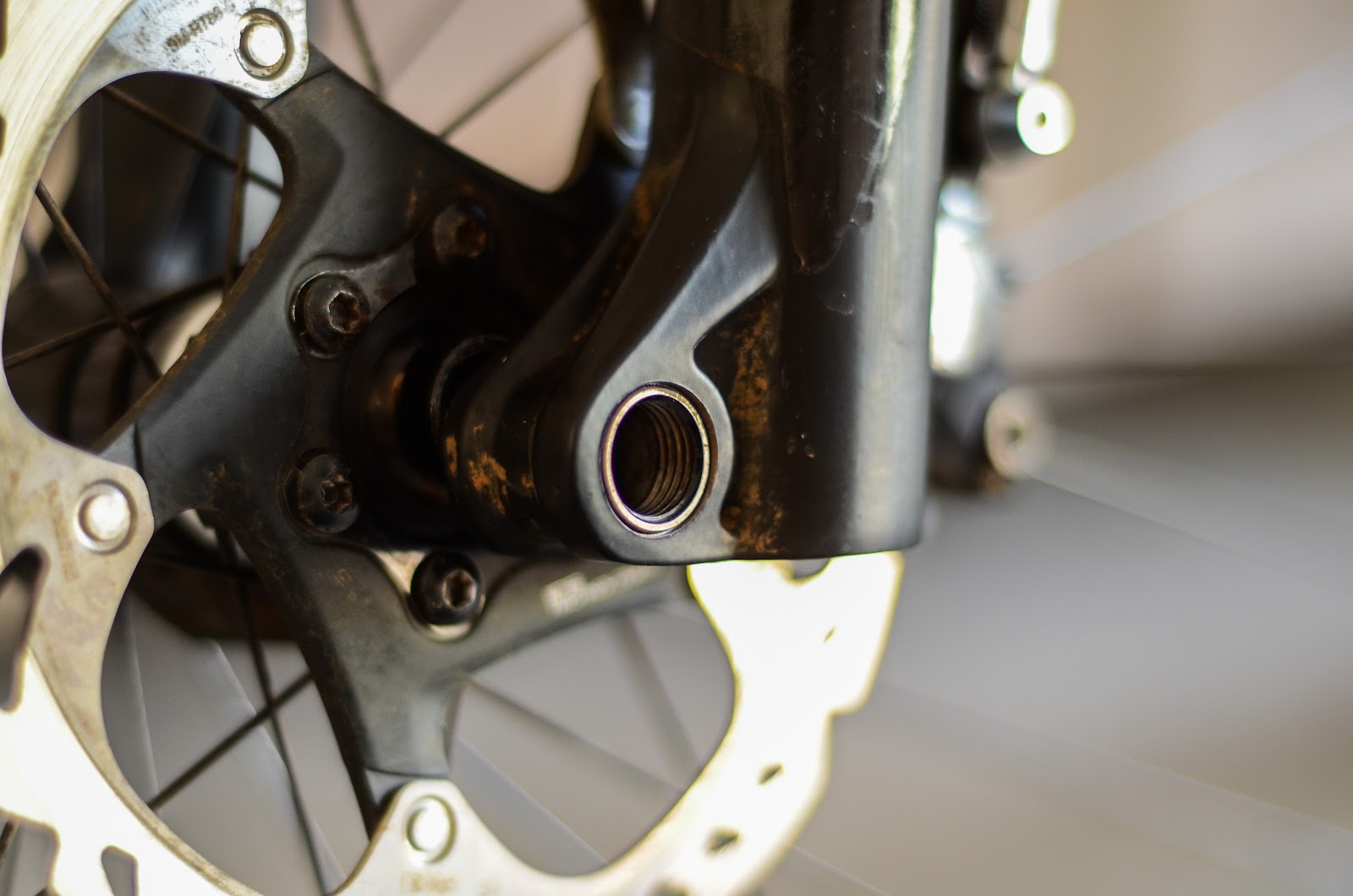
DSC_4026.jpg

Interestingly, the rear hubs themselves are still 135mm, but the frame has 3.5mm cutouts in the rear to allow the hub to be more easily guided into place before the axle is inserted through the frame and hub and bolted tight.

All of this is to say that thru axles represent a stiffer, more robust form of wheel to frame attachment that, in general, results in a more responsive and predictable ride through the trails.  The “size” of your thru axles depends entirely on the type of bike you buy, with 15mm being a common front axle for everything except the biggest hitting (mainly downhill) bikes, which use 20mm.  In the rear, you will most often find 12mm thru axles. The only real downside to a system such as this is that it can take a bit longer to change a flat.  Especially with the axle type that’s in the middle in one of the above pictures, as it requires carrying allen keys. A little extra preparation never hurt anybody, however, and the increased stiffness and precision is DEFINITELY worth it.

DSC_4027.jpg

Now that I’ve said that, I feel bad for my next and final section.  Like with anything in the bicycle world, nothing remains “standard” for very long.  Enter what is called “boost” spacing.  Most simply, this “standard” (ha. ha.) replaces 100/142mm with 110/148mm.  Big whoop, you say? I agree, mostly. But let’s dive into a little deeper to see what this difference REALLY means.

One of the changes between 26” and 29” wheels is the size of the wheel (umm, duh.). This larger diameter wheel has many benefits, which we’ve already highlighted.  One of the things it has that is potentially a negative, however, is longer spokes.  These spokes, despite being attached to the same width hub (100/135) are significantly longer, and are attached “further out” in the triangle.  The boost standard is designed to allow the triangle to have a wider base - as each spoke is attached to the hub a few mm further outboard - which results in a stronger, stiffer overall wheel.

What may seem like a subtle, small change actually has a huge effect on other parts of the bike.  You must now have wider frame dropouts and a crankset that moves your chainring a bit further out to accommodate the different rear hub spacing (this is done to maintain what’s called the chainline, which is chain deflection - or how straight or not straight a chain is - in the middle of a cassette).  The frame itself has a bit more clearance, which allows for wider tires and better mud clearing.  But the endgame here is that this new “standard’ (I still chuckle every time I hear that in the bicycle industry) really requires entirely new bicycles designed around the standard.  New wheels, new bike frames...it’s almost like the bike industry wants you to buy new stuff!!? Who would’ve guessed it...

Thursday, September 21, 2017

Performing exceptionally or exceptionally under-performing

It's been interesting watching Christine race and being engaged in her races and who she has racing. It's a departure for me, as I usually really only care about myself. Historically, anyway, I am very selfish when it comes to racing. But over the past year I've watched her and her competition and a few things have stood out to me.


1) Women are significantly tougher than men

Now, those women out there who read this will not likely be surprised by the statement. But all the dudes out there who read that in shake their head in disbelief, I feel sorry for you. On the whole, women kick your ass up and down the [triathlon] block.

Sometimes I feel like the last 5k of a 70.3 run is pretty tough. It hurts, I'm whining, I just wanna be done. Then I imagine pushing a human out of what is essentially my butthole and I'm back to reality. I don't have it that hard.

2) By that same token, women are much more likely to f*** themselves up from training than men

Maybe in part BECAUSE women are so tough, they seem much more inclined to treat training a little differently than men do. For example, if I don't feel that great or I don't hit my watts, I just kinda whine a little bit and either change my workout or just stop; explaining to my coach that "I didn't feel that good." The thought of Christine doing this kinda makes me chuckle, because she - like most women - will dig super deep to nail workouts. Sometimes it's detrimental. Maybe it's not "worth it" to use those little bits of toughness that you have stored in your lady genes in certain instances?

I think most coaches would agree that you tend to treat women differently from men. Men you have to encourage and mollify all while appealing to their ego and/or insecurities. Women you just have to hold back and help them not do too much damage.

There are a few women that have been on Christine's radar at most races over the past year. They are very fast and historically near the top of the female age group field. But for almost this entire year, a couple of them have had serious injuries. Injuries serious enough such that they don't race or they blame a bad race on these injuries. Even more interestingly, at least two of them are coached by the same high profile coach. When they are "on" they are VERY "on" but the downside appears to be injured and poor performances.

So the moral of this story is: it's better to be smart, consistent, and slightly back from the "over-reaching" line while maintaining an extremely tough mental focus but not at the drawback of added emotional stress all while pursuing racing at a high level!


Saturday, September 16, 2017

Ironman 70.3 World Championships

Well, I suppose that after all this lead up I suppose I just HAVE to recap the event. Wouldn't want to leave any one of the tens of readers out there hanging by the thin thread of blogspot anticipation.

I came into this weekend unprepared and undertrained. But that was ok! It was, in effect, on purpose. No injuries to speak of and no weird ailments to derail training were in my way; my self was in my way. But it was a low stress weekend, at least for me. My goals were simply to watch Christine dominate as much as possible and then have a solid event myself on Sunday. Getting up early Saturday to spectate and help Christine in the morning was tough knowing I'd have to do the same thing myself in 24 hours, but it was worth all the time on my feet and in the sun throughout the day to see her race so well. Not my normal pre-raceday routine, but well worth any fatigue or soreness it added to the weekend.

My own race morning dawned bright and early and everything was very smooth leading to my race start time of 8:22.

Swim - 31:07

The rolling wave start was kind of cool and unique, so I was excited to try out a new format. I figured the swim would be relatively tough, but after seeing the pro males swim 23ish I knew that we were potentially not facing as much current as the ladies did on Saturday. Given that I only had a swim skin I was pleased with that.

Further, given that over the past 13 weeks I have averaged about 1hr in the pool per week...I was thinking it might be a slow, rough swim. Be that as it may, I dove in optimistically after seeding myself in the 28-30 minute section. I ended up passing quite a lot of athletes throughout the race, so the suspicions of over-seeding by guys was very confirmed. The swim was pretty uneventful and wasn't difficult, relatively speaking. I was working a steady pace and dealing with the chop and very mild current without too much trouble, although I had no time reference until I got close to the end of the pier (about 200m to go perhaps?) and glanced at my watch, which read 29:xx so I knew my time wasn't going to be blazing fast.

T1 - 3:52

This was a pretty long run up to the transition area and a long run through transition area so my time wasn't particularly speedy, but I didn't waste any of it.


Bike - 2:42:06

The bike was where I figured I'd lose the MOST time at this race. Everyone is an uber biker at a world championship (or certainly thinks they are) so I knew with my paltry fitness that I'd have to play it safe or I'd suffer the consequences on the run. I figured 190-200w was a pretty good goal that would probably result in a 2:35-2:40.

I took the climb pretty easy and was passed quite a lot and it was a while before I got the change to enjoy some overtaking myself; on the downhill section I re-passed a few who had passed me and settled into somewhat of a rhythm. I continued on uneventfully for most of the race, taking in calories throughout and trying to make up for a dropped bottle early on in the bike meant that I was grabbing and chugging at aid stations.

There was relatively little drafting, but I was very solidly in the middle of the pack as far as the overall M30-34 race goes so I can't comment on other parts of the race. There were a few offenders who were mostly from countries in south america (I know this because they had their country on their tri kit). That was pretty annoying.

At mile 35 or 40ish I had to pee so bad that I could barely get into my aerobars. I had to pull over at a porto into which someone had just entered so my pee break ended up being a little longer than ideal (2mins) but the relief was priceless. I needed the aerobars for the last 10 miles or so and got off the bike feeling ok with my effort although I was a little sad that my bike time was bested by Christine's from the day before :(

T2 - 2:18

Nothing to see here, except talking to a guy who had been drafting the last 10 miles on myself and a couple other guys. Someone else actually called him out in transition as well. Down with the cheaters!

Run - 1:29:03

I have been the most consistent with running over the summer, so I figured I had a decent chance at a solid run. I underestimated the difficulty of this run course, however, as I was unaware of the 2 serious climbs on the other side of the river...

I started off way too fast, for sure, as my first mile was 6:20ish and basically entirely uphill. I knew Christine and fam would be at the underpass so I made sure to "raise the roof" and yell real loudly when I passed. Unfortunately this ruined pictures of me as I look like a moron but, all in all, I'd say it was a fair trade.


I carried on for a while and the first real nut-puncher is just before mile 4ish and it was a real short but steep hustle. That was kind of the first "oh shit this could be rough" moment of the run, so I slowed down and took it conservatively before getting back on the gas and over the bridge. Shortly thereafter we had another monster climb followed by a nice descent then another monster climb then another sharp descent and then we got back to the pedestrian bridge to head back south across the river and loop #2. I was in a pretty solid rhythm and clicking off relatively consistent miles without feeling too bad. I was not enjoying my gu but I WAS enjoying red bull for the first time in a race, ever.


Normally I'm not a red bull fan, but that ice cold piss looking drink was oddly satisfying. Perhaps it was the caffeine? Lap 2 was more of the same, but slower, as I really started struggling on the uphills. I knew that my time was going to be close to what Christine told me her time was (I didn't remember specifically) so that last mile involved some hustle to try and make sure I

a) beat her

and

b) snuck under 1:30


I was glad to be done and honestly pretty pleased with my effort!

Overall - 4:48:26 (142/318)

So yea, not the fastest time, but it was the best slow race I've ever had! So that's fun and exciting. It was also really nice to kinda take a step back and race without the normal "nobody else matters as much as me" attitude that I have historically normally raced with. Taking the time to pee, while a bit frustrating, was amazingly revelatory as it obviously did not affect my race at all. 2 minutes is a long time but realistically, unless you are fighting for the absolute age group win (i.e. top 3) it's not such a bad thing to take a chill pill. I loved that feeling!

Thursday, August 31, 2017

Exercise vs. Training

With World Championship 70.3 approaching quickly, I think I should dissect a crucial element in my preparation for the event.

I stopped "training" in mid-May. Although I ended receiving daily schedules back in November of last year after Maui, I got into pretty solid shape during the winter and early spring by hanging onto the coattails of those much better than me. By doing Christine's workouts with her and riding the various group rides occasionally along with some long stuff with some V10 powered pros I found myself to be ready for Santa Rosa. I was even pretty ready for Deuceman, as I continued to ride the wave of that fitness.

Once that was over, I got back into a groove of exercising. It's actually incredibly refreshing to work out 10-15 hours a week but completely on my own terms. You should try it sometime!

That being said, "exercising" does NOT make you ready to tackle the best age groupers in the world for 4-5 hours. I have solid run fitness due to my ongoing run streak (10+ weeks), laughable swim fitness, and a 2.5hr power on the bike that's probably dropped 20%. So, instead of trying to go sub 4:20 (or maybe sub 4:30 looking at this course), sub 4:50 is going to be a pretty solid achievement.

Which is all kind of amusing to me, in some ways, looking back on what I used to want out of triathlon. Race finishes and crushing workouts helped me define myself and my self worth. Was that healthy in the long term? Absolutely not. It "worked" for 3 or 4 years. Then my motivation and fitness fell off a cliff. But that's ok, because I know I am a good athlete who has worked hard for a while and has decided that I want different things out of my swimming, biking, and running.

So when Christine beats me next Sunday or when you pass me on the bike looking aero but moving slow don't say I didn't warn you! You get what you prepare for.

Friday, August 25, 2017

Cross training

I alluded to this in my last post, but I figured I'd go a bit more in depth as I search for things to write about and keep this antiquated blogspot.com domain active.

I played a lot of sports growing up: soccer, track and field, flag football, tennis, baseball, golf, and probably some others I am forgetting. In fact, in 8th grade I won the "Chiggy Rhodes Athletic Award'' at Trinity Episcopal back in N'ahwlins. What did that award represent? Well, it means I was the best all around athlete in my graduating class (of < 30 kids). So yea, it was a major award.

I stuck with soccer the most consistently, I'd say. I wasn't all that great but I enjoyed playing and I tried out for my high school soccer team but was relegated to JV squad. I didn't like how seriously the coach made us take it and only played for one season (maybe it was even less than one season). I picked up golf and rode that wave up until senior year of HS.

But then in college I decided to major in Intramural Sports (not really, but kinda really). Our freshman dorm hall was a great group and a solid core of us played together throughout the 4 years of school. Soccer was definitely my favorite and I was "better" than I was when I played up through high school (puberty can do wonders for physicality) as I got a LOT faster. Indoor soccer, outdoor soccer, you name it we played it. One year our team (DP) won the overall intramural championship; I couldn't tell you what that means but it was somehow points based.

Anyway, that all ended in 2007. Fast forward to 2017 and I haven't played soccer seriously (i.e. continuous games and not just kicking around) in 10 years. I am very fit, aerobically, but not laterally. I am good at steady state efforts, not sprinting and stopping. But I decide to play for a couple of hours anyway.

Let this moment be a reminder to everyone that there are consequences to all of your decisions...

Holy cow. I am sore in ways I had forgotten were possible to be sore. Hip flexors, quads, adductors, psoas, upper glute, side glute, calves, achilles, IT band, etc. It's my own fault but DAMN it's a reminder that I am not as young as I used to be! I feel as though I NEVER used to face consequences to decisions like this back in my early 20s. I could do whatever I wanted to do and emerge none the worse for wear in the days following.

Don't get old!

Wednesday, August 23, 2017

Back in the CLT (for a bit anyway)

If 2017 could be said to be about one thing and one thing only, I would say that it's been about not blogging. But I feel compelled to write one now that we have been back in Charlotte for a little over a week (albeit temporarily). Here are some things that have stood out to me since returning:

1) So. Many. People.
2) Everyone must basically be rich now as the real estate market is ridiculous
3) The real estate market is ridiculous
4) The city can't handle the load
5) Heat vs. humidity

Let's settle this once and for all. An argument with myself to end all arguments with anyone else.

Pros of "dry" heat (Southern AZ)
  • sweat evaporates
  • I can wear clothes and not be any hotter than without clothes
  • misters work
Cons of "dry" heat
  • Can't / Shouldn't work out in the outdoors past about 11am. If you must, be extremely hydrated and have sunscreen on you in liberal amounts/coatings
  • It's really f***ing hot
  • See above
Pros of "humid" heat (Southeast)
  • It's not really that "hot" (as compared to aforementioned ''dry'' heat)
  • You can workout all day, but it will probably suck
  • Great excuse to go shirtless all the time
Cons of "humid" heat
  • You are wet, all the time. Like, soaked. Shorts become ... something other than shorts. Kinda spandex-y but without the sexiness.
  • It's difficult to breathe outdoors because you don't have gills
  • Not possible to see out of your windows in the morning because they have so much condensation from the AC vs. humidity battle. Never know what's out there.
In other news, I have been exercising regularly. "Training" is not really the word I'd use to be perfectly honest, but I am [relatively] fit and am enjoying myself. World Champs will not be an epic throwdown of raw speed, but I am sure I'll handle myself decently. I'm actually at a streak of a hair over 10 weeks straight of running every day. During that time I've averaged roughly 40mi/week, which isn't too bad. I played soccer for the first time in about a decade last Wednesday, which came really close to putting the streak (my stated minimum is 20 minutes a day to count) at an end the next day! Funny how specific your "fitness" becomes after years of doing the same thing! 

I may be able to run circles around most of the players but when it comes to lateral movements and bursts of speed (and kicking, which is a fairly violent motion for your quad, hammies, and hip flexors, and adductors, and glutes, and...and and) I am certainly NOT fit.

I may very well get beaten by Christine come race day, but if that happens I will merely mark it as the beginning of a new streak where she beats me regularly (in racing). 

Monday, June 19, 2017

A Year in AZ

Tomorrow (Tuesday, if I finish this before then) marks the first year of our residence here in Tucson. Somewhat coincidentally, we arrived during the hottest week of the year (highs north of 115), and this week will also be the hottest week (by far) of the year, with temperatures equal to those to which we arrived.

Sure, it's a "dry" heat. But lemme tell ya, 115 is hot AF no matter how much moisture is in the air.  Interestingly, the warmer air is, the more moisture it can hold in the air. So when it's 115 at 60% humidity, there is actually a LOT of moisture in the air. So 60% doesn't sound like a whole heckuva lot (compared to 90+) but it actually can feel humid here in the desert. Especially during monsoon season. Yes, there is a monsoon season here. Who'da thunk it?

Since my last blog was a race recap, I think that this one should not be. Although I have since done another race, so I'll discuss that briefly.

Deuceman Half (yes, that's the real name...) was the first Sunday in June.  A friend and training partner Jesse V was also going to race and given that he is both racing professionally and is faster than me I knew he would beat me. I wanted to stick with him for as much of the race as I could, however. This was accomplished during the swim (we emerged together), decently during the bike (he put about 1.5 minutes into me), and not so well during the run (down another 9 minutes). By the end this meant that I had come in 2nd to his 1st by about 10 minutes. I barely missed going under 4:30, which was a "slow" time but given the race was at elevation in Show Low (yea, real name), AZ (6200+ feet) I was not displeased with this performance. The swim and bike were pretty cake, although watts on the bike were a little low due to the elevation (but conversely, the air was thinner so we moved quicker through it than at the ~2500ft of Tucson), and the run was the real ass kicker.


Swim Start

Jesse and James

Coming into T2

"Running"

Most importantly, however, was the fact that I executed a better overall race than in wine country. This was pleasing. What was more pleasing was traveling to a new place and having Christine cheer for me. I felt special as I'm usually the one cheering for her...

Since then temps have been going up, but we've managed to get by so far with a combination of complaining, AC, pool time, and staying indoors. Any outdoor working out that isn't a swim should probably be finished up by 10am. Swimming and then running (unless it's on a treadmill) is ill-advised. It's sort of hard to relate to this, I think, for you in the Southeast (which is most people that read this blog). You think anything has got to be better than the 90% humidity and high dew points of the summer, and a lot of the times the heat here is definitely better. But, I could work out in the summer evenings back in NC. You cannot (/should not) workout outdoors in the evening here, as it is still well over 100 degrees. You will bake like a take-home pizza that is left in the oven for too long...! Not worth it. The 3 months of heat advisory here is a small price to pay for the unbelievable winters, however. We'll take it.


Monday, May 22, 2017

Santa Rosa 70.3

It seems as though the blog has reached rock bottom. It only comes out when I'm desperate and have essentially been force-fed something to write about. Nothing has been coming quite as "naturally" as it used to, which has surprised me. I expected, given the change in scenery and context that I'd become even MORE prolific (I know, you'd like that, wouldn't you?) but that has not been the case at all.

Well, faithful readers, I now have something to write about! Rejoice!

I almost quit triathlon over the winter of 2014-2015.  Saying "quit" insofar as triathlon is concerned is a bit odd because it really is more of a lifestyle choice, at least for me, than it is an all-or-nothing hobby. I just enjoy running and cycling. Sadly, I do not always enjoy swimming and feel like I really ONLY swim because I do want to RACE triathlons. I'm never going to be a "completer" when it comes to a hobby I pursue, I don't think. Even if it's something I've never done before I still want to "beat" others and I'm not sure I can rid myself of that compulsion.

But yea, I almost didn't really want to race or TRAIN anymore from that point. I am making a distinction here between "training" and "exercising." To me, "training" is exercising with a focus or goal, whereas I could still be riding my bike 12-15 hours a week but if I had no race or competition or objective I'd simply consider that exercising. To be good at competing, TRAINing is absolutely necessary. To be fit and happy, exercising is absolutely necessary. But the differences between them can make your mental approach to them vastly different.

I was mildly burned out on road triathlons, but I still had an Ironman to do in 2015. I clawed my way back in to shape with the guidance of DTD and felt very prepared for Louisville, but along the way I had significantly more fun racing XTERRA Oak Mountain and XTERRA Utah. Unfortunately, as you're probably aware, Louisville did not go so well and that sealed my deal for 2016 race ideas. Off road won out and I did 3 big XTERRA races in 2016. I did pretty well at each, competing at Maui (a World Championship in triathlon) and feeling satisfied with my year. It was interesting, however, that people still seemed to assume that I had "quit triathlon" that year. I was asked, more than once (and by different people), why I "quit" or what led to me not wanting to race anymore. That pissed me off. The relegation of XTERRA to being a sort of "side show" that doesn't matter to anyone (sponsors, "regular" triathletes, teams, manufacturers, etc) was frustrating.

So I ended 2016 not really being sure what I wanted to do.

Living in Tucson has crafted the answer to that question a bit, as I actually ENJOY riding my road bike here whereas I absolutely did not enjoy riding my road bike in Charlotte. The roads felt, quite simply, too dangerous and I relegated myself to weekday trainer rides or mountain biking and only really getting out on the roads on the weekends.  Here in the desert, however, I feel much safer on the roads. The huge variety of routes I can access from the front door of our house makes it eminently more enjoyable. Mountain biking here, on the trails near our house, is just plain HARD. It is fun, but it is not as fun as NC, where trails were groomed and purpose built for mountain biking. They were, in hindsight, real easy.

So, Christine convinced me to sign up for Santa Rosa. I had kind of accidentally gotten to be in real good shape in January and February, so why not carry that fitness into the year and bust out some road triathlon-ing? Why not indeed, says I.

The last half-ironman I did was June 2015, and that didn't go so well.  The last GOOD half I did was July 2014, at Challenge New Albany. So my previous 3 half-iron races had been something like 4:50, 4:50, 4:09.  I think 4:09:04 is my PR, but I can't find results from Rev3 Florida 2013, which was right around there and might have been just under 4:09. Be that as it may, I figured SR 70.3 would potentially be a "PR" course based on the profile of the bike and run, while also knowing that the swim would be wetsuit legal (neither of my two previous fast times were in a wetsuit race).

My preparation for SR was solid, but not extraordinary. I probably did not spend enough time on my tri bike in the aero position, but I had some good solid workouts in the aerobars and felt confident that I could put together a fast race.

Christine and I flew up late Wednesday night and got most of our race prep done on Thursday such that the only thing we had to do Friday was give our bikes to TriBike to shuttle to T1 (they provided a service at this race such that you didn't have to do this yourself, which saved us 1.5-2hrs on Friday) and set up our T2 bags.

Race morning involved a 3am wake up, which might be the earliest I have woken up for a race.  The shuttles to the swim start (about 45 minutes away) were easy and pain free and we arrived with ample time to setup everything and even get in a bit of warm up swimming.  I was going to line up in the front of the rolling swim start (or near it) and Christine a bit behind that so as the time approached we wished each other luck and got in our chosen spots!

Swim 1.2 miles - 27:55

I was excited about a rolling start for a couple of reasons:

1) I wouldn't have to wait around for my wave (when this race was going to be a wave start I think M30-34 was one of the last waves).
2) I'd get to be one of the first AG athletes on the bike course
3) I'd probably experience less anxiety than in a wave start

Regarding #3, I was just hoping to avoid an experience like XTERRA Utah, where I had a mild panic attack and had to swim backstroke for a minute or so to collect myself.

The water was somewhat chilly (64ish maybe? Can't remember what they said) but never noticed it during the race itself, just the warm up. I started out smooth but the swim felt very crowded for the first 400m, where we made a right hand turn and were no longer headed into the sun.  From that point on I never really had any crowding, so I'm not sure if my perception was just due to the sun being in my eyes (and basically only being able to see splashes) or actual crowding. The swim was nothing to write home about (wait...) but I did keep steering to my right for some reason, which I found annoying. I would say I did not push this swim as hard as I probably could have, but I was - again - trying to avoid scenario #3 mentioned above. I figured I might be able to swim 30-40s faster but the cost might be higher than that in the long run. In hindsight, I probably should have pushed it harder starting at about half way.  Oh well, hindsight (especially when blogging) is always 20/20.

T1 - 4:44

This transition run was easily the most "legit" of any race I have done. A long and steep boat ramp followed by a long and steep road up to an upper parking lot meant a lot of distance and gradient needed to be traveled. I did not store any shoes at water exit (which quite a lot of people did) and I would probably do that again. I did, however, take my wetsuit off right at the bottom and threw it over my shoulder for the run up to my bike. My feet were very cold and by the time I got to my bike I really couldn't feel them anymore, just a general sense of pain. I put socks on in T1 and was methodical in my movements so I would not describe this as especially fast, although it was not slow either.

Bike - 56 miles - 2:17:57


I passed a few people early on and also installed some light gloves. The course went downhill steeply, then flat, then uphill in the first 8 or 10 miles and my left hip flexor was mildly cramping here and there, which gave me some things to think about in the first 30 or so minutes. Luckily, that stopped, and I continued on for a while without thinking too much. I passed some guys for a while then didn't see any but started passing some of the pro women. I figured there'd still be some EMJ athletes ahead of me as they all seemed to gang up at the start line of the swim.

Somewhere in wine country. Thanks for this $25 photo FinisherPix...

I started to get pretty bored but continued to hold some power and consume liquid calories without too many issues. Jenson Button came up on me around mile 40 and he was the first person of the day to pass me, but another guy passed me and then Jenson shortly thereafter. I knew Jenson was a pretty good runner and was not worried about the other guy (he didn't look like a good runner) and both were in different AGs anyway so I wasn't going to kill myself to keep them around on the bike.

The last 10 miles were a little rough as I honestly just started to lose focus. My power dropped, my interest level waned, and I was ready to be off the bike. I knew that once I was running I'd LOVE to be back on the bike, however, so I finished the bike with that happy mental outlook fueling me ;)

T2 - 2:02

Pretty quick. My rack spot was right at the beginning of transition, so at least 30-40+ seconds of this are running from my rack spot to run "out" at "race pace."

Run - 13.1 miles - 1:24:44

The run course, on paper anyway, looked like it was gonna be pretty darn fast. I didn't think I was in PR shape (sub 1:19) but I did think I was realistic to account for 6:10 pacing. I held that without too many problems for the first half of the run, and passed a few more pro women (and almost got knocked out by Matt Dixon's back who was not paying attention to oncoming traffic while shouting encouragement at one of his pro athletes...) and a couple of guys as well. It turns out the first 4 miles were slightly declined, but there was a few sharp turns and bridge crossings that slowed the pace down a bit and kept the rhythm of the run a bit off kilter.

As we started heading back into town, I started having to work a bit harder to hold the pace I was shooting for. Normally I carry a gel flask in my hand and take a squirt of gel before every aid station where I then get some water or gatorade (or coke maybe, as my mood swings).  This time I had a gel flask but it was in my rear pocket which, while easy to access, was not as easy as my hand. So in the first half of the run I probably only took one squirt of gel, a fact that I think would prove to be a downfall as the miles progressed.

Coming back into the main area got a bit more crowded and my pace slowed some more, although it held at 6:30s and I attributed this slowing to the increase in traffic on the path (90% of the run was along a river path, about 5-8' wide depending on where you were) but signs were pointing towards the fact that I was just blowing up a bit.

I kept on trucking but my legs just did not want to turn over much more. The last 3 miles were a real struggle and I was working HARD to break 8 minute miles! Jenson passed me back and an EMJ guy also re-passed me, which was a bit frustrating but there was nothing I could do at that point. I just focused on limiting any damage and crossing the finish line.

Mile splits:
6:05
6:10
6:11
6:07
6:09
6:11
6:15
6:29
6:23
6:28
6:48
7:27
7:42

5k splits were 19:06, 19:08, 19:52, 22:04


Finish - 4:17:22 - 3rd M30-34

Overall I was quite pleased with the race. I think, on this day, with better execution, I could have achieved a 4:12-4:14...which would have put me in contention for top 3 amateur. Be that as it may, there's a good reason I probably didn't execute perfectly: I'm out of practice! If this race had been 1.2 + 40 + 8 I would have been much better off! I don't think my issue is fitness, either. Regardless, it was fun to get back out on the roads and while I didn't achieve anything close to a PR, I was competitive in a west coast 70.3, which is something to be pleased with. I know that I cannot bring the same level of fitness and execution to World Championship 70.3s, however, if I want to be at least somewhat competitive in my AG.

So back to the pool!

Next week...